
The Supreme Plate Spinner
By Debbie Frith, Boost and Beyond Business Solutions
Self-employment offers flexibility that traditional jobs can’t match, especially for business owners with caring responsibilities or families to manage. But that flexibility only works if you manage it with intention. In this blog, business mentor Debbie Frith shares what more than a decade of self-employment has taught her about setting boundaries, staying on top of the work, and building a business that supports the life you actually want.
I recently took my business on the road because I needed to, and because I can.
My teenage daughter had work experience lined up in Frome. Nothing suitable was available closer to home for what she wanted to do, so I told her: wherever you go, we’ll get an Airbnb, and I’ll take my office with me, and we’ll make it work.
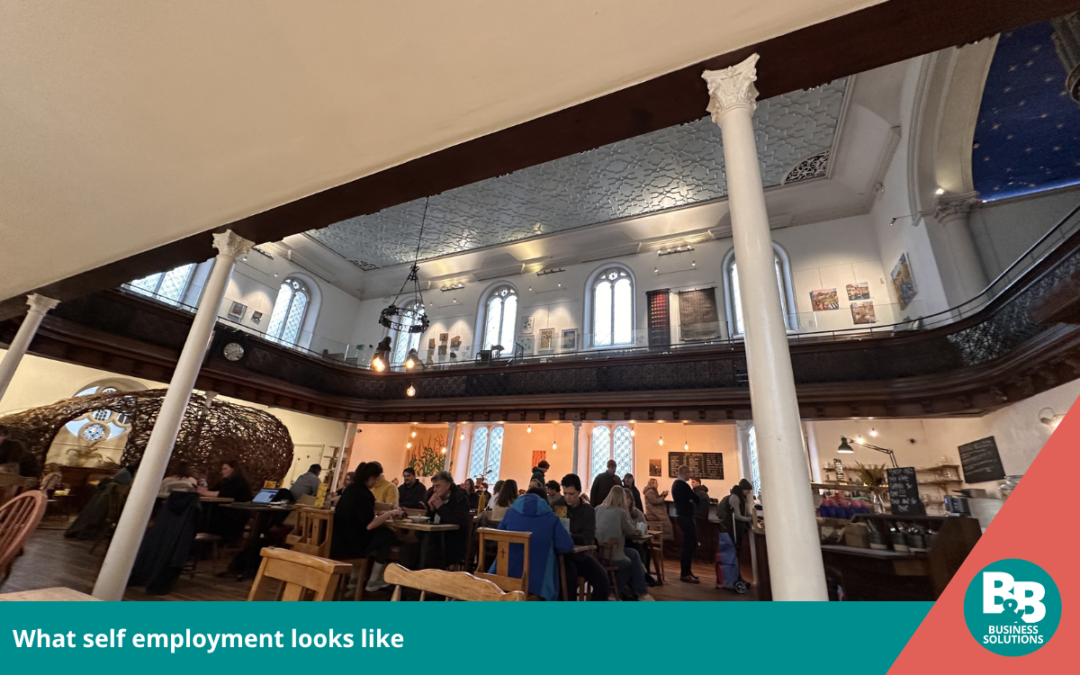
And we did. I spent a few days working from a cottage, then from a converted church that doubles as a co-working space, eating pastries, drinking far too much coffee and paying my way as this kind business let me tuck myself into a corner with their Wi-Fi and electricity. I’ve spent a small fortune there. I couldn’t do it every day; I’d be broke and another two dress sizes bigger.
The time in Frome was a good one, and served to remind me of something I discuss with business owners I mentor: the flexibility of self-employment is only an asset if you actively manage it. Left unchecked, the same flexibility that lets you decamp to Somerset can become the thing that blurs every boundary you’ve set.
What does juggling self-employment and family look like?
I consider myself a supreme plate spinner. I’m a mum (first and foremost) to the most wonderful teenage daughter. I’m a wife to my husband of over 30 years. I’m a carer to my elderly parents, aged 82 and 92. And I’m a business owner with a client list in double figures, and growing.
At this stage in my life, I don’t think an employed role would work for me. That has nothing to do with becoming unemployable after years of self-employment. It’s that the flexibility I need would be almost impossible to find in a traditional job. Hospital appointments for my parents don’t respect office hours. A teenager’s work experience placement doesn’t wait for a convenient gap in the diary. Life happens on its own timetable, and my business has to fit around it.
That fitting-around requires constant adjustment. I’ve evolved my services, my working patterns, and my pricing as I’ve found my feet. The business I’m running now looks nothing like the one I started, and that’s a good thing. Rigidity is the enemy of longevity in self-employment. But flexibility without structure is just chaos with a nicer name.
How do you stay on top of everything when you work for yourself?
Working for yourself is not for the fainthearted. You keep yourself motivated when there’s nobody holding you accountable but you. You wear all the hats until you can start to outsource some of them. You market your business, deliver your services, maintain your finances and take care of your clients. And all the while, you try not to forget to take care of yourself.
I know this because I’ve got it wrong. More than once. The signs are always the same: my to-do list grows faster than I can clear it, I start saying yes to things I should be declining, and I begin to feel resentful about a workload I created myself. Those are signals that my boundaries have slipped, that I’ve let the flexibility of self-employment stretch into territory where it stops serving me.
When I spot those signals now, I call a hard stop and reset my intentions. A re-establishing of the boundaries that were working before I let them slide. I’ve learned (the hard way) that the reset is the discipline, not the deviation from it.
I suspect I’m not the only one. If you’re self-employed and you’ve never hit that point where the flexibility you chose starts to feel like a trap you built yourself, I’d be surprised, as it catches up with all of us eventually.
What makes the difference between thriving and just surviving in self-employment?
After more than a decade of self-employment, I’ve landed on a few things that make that difference. None of them is complicated. All of them are easy to let slide.
The first is surrounding yourself with the right people. ‘Yes’ people are lovely when you’re having a wobble, but you also need people who will tell you when you’re overcomplicating something, heading for burnout, or kidding yourself about your capacity. Good people care enough to have the uncomfortable conversations. Find them and keep them close.
The second is talking to other business owners. I know networking can feel like a chore when you’re already stretched thin. But people who run their own businesses understand the pressures in a way that friends and family, however supportive, often can’t. Your sanity will thank you for it, and so will your business, because isolation breeds blind spots, and blind spots cost money and time.
The third is one I’m disciplined about, sometimes to my own detriment: keep on top of the back office. Marketing, accounts, invoicing, and admin. The boring stuff that holds the business together. I won’t let it slip, and that’s a good thing, but the reality is that staying on top of all of it, on top of client delivery, is sometimes the thing that pushes me over the edge. The work still needs doing, and the trick is recognising when the weight of it all is a sign that something else needs to give.
And the last one, which underpins everything else: permit yourself to get it wrong. Self-employment is a constant process of adjusting, learning, and readjusting. The goal is to notice when things are slipping and course-correct before the wobble becomes a crisis. That’s a skill, and like any skill, it gets better with practice and honest reflection.
Is the flexibility of self-employment worth the pressure?
For all its messiness, self-employment gives me something I couldn’t get anywhere else: the ability to build my work around my life rather than the other way round. I can take my office to Frome. I can drive my mum to her appointment and make up the hours another time. I can choose who I work with, how I work, and what I work on.
But that flexibility only stays an asset if I manage it with intention. The same is true for every self-employed person reading this. The freedom is real, but so is the risk of letting it run you instead of the other way round.
Some of this is the work I do with the business owners I mentor. Helping them step back far enough to see the patterns, put the right structures in place, and build something that supports the life they want. The challenges I’ve described here are just one version of what that looks like. Every business owner’s situation is different, but the value of having someone in your corner who gets it stays the same.
If you’re a business owner who recognises yourself in any of this, whether it’s the plate spinning, the boundary erosion, or the creeping feeling that you’re working harder than you need to, I’d welcome a conversation.
Drop me an email at debbie@boostandbeyond.co.uk and tell me what’s on your mind. Sometimes that’s all it takes to start getting things back on track.
Debbie Frith is the founder of Boost and Beyond Business Solutions, a business mentoring practice based in Dorset. With over 30 years of hands-on commercial experience across hospitality, manufacturing, and business support, she helps SME owners and solo business owners make better decisions, build sustainable businesses, and stop trying to do it all alone. Debbie is a member of the Association of Business Mentors, a Dorset Ambassador and an Ambassador with the Total Business Network.